
Due to the evolution of Artificial Intelligence, the restaurant and food industries are undergoing a massive transformation. Predictive analytics is one of the most powerful tools among other AI tools. It helps food businesses to increase profits, streamline operations, and minimise wastage.
This AI utilises seasonal trends, historical data, and customer behaviour to predict what customers are likely to order. This predictive analytics helps businesses to manage kitchen operations, optimise inventory, and manage fluctuations in demand. Forecasting demand is one of the needed factors in the food industry.

Predictive AI and its working in Food delivery apps
Predictive AI analyses huge data to predict the future with more accuracy, like delivery. The data sources are delivery time, order history, weather conditions, peak hours, and festival season.
From this data ML learns and predicts, such as how many orders will be recive during peak hours, which item will be more popular, and which ingredients need to be stocked more. It continues to learn from the restaurant performance and customer behaviour.
Why Demand forecasting is a must for the Food business
In advance, it helps in understanding their customers’ preferences. Without a forecast food business will either struggle with little stock or too much stock, both result in loss. This Predictive AI will remove the process guesswork, like what will sell most, and how many staff will be required.
Prior prediction using this AI will help in maintaining stock effectively, can provide more accurate customer service, reduce operational costs, and improve delivery service.
Menu Predictions to understand Customers’ Expectations
Apps with AI will help businesses to understand customer choices. For example, customers may prefer ordering non-veg meals and briyani on weekends when compared to weekdays.
Food apps can use this data to modify menus, highlight items, curate combos, and introduce new offers and discounts. Predictive analytics may help in identifying low-moving food items and highlight the most preferred items by customers.
Inventory Management Optimisation
Maintaining raw materials is the main challenge that is faced by food businesses. Predictive AI helps in managing the stocks perfectly. Using the data, it alerts the business owners which items are going to expire soon and how much they need to restock.
This results in reduced wastage and allows restaurants to use fresh ingredients always. Predictive AI improves operational efficiency and also saves money.
With Smart Forecasting, food waste can be reduced. Due to improper ordering and planning, there will be wastage of food by restaurants. Predictive AI identifies the pattern for the waste of food and provides a solution for preparing the needed food quantity. Predictive AI plays an important role in using the ingredients more efficiently without wasting them.
Personalised recommendations based on AI
For each customer, the food app provides personalised suggestions by using predictive AI. Recommendations such as past orders, favourite cuisines, and the items that they usually prefer to order. This boosts revenue and improves customer satisfaction.
For example, if a user regularly prefers non-veg dishes, then the food app may suggest new or trending non-veg dishes. These personalised recommendations reduce customers’ spending time and also help with easy checkout and recurring orders.
Festival and seasonal trending predictions
The demand for food is significantly influenced by festival seasons, special occasions, and holidays. It examines customer behaviour and festival data to predict which will be in more demand during the New Year, Diwali, Christmas, and other regional functions. By using this analysis, food business can update their menus, create combos, launch new dishes, and manage inventory.
Staff Scheduling and Optimisation
Predictive AI also plays its role in managing the workforce of the restaurants. Based on the predicted orders, it can suggest how many workers are needed, like how many chefs, how many support staff, and how many delivery executives are needed for that specific day.
For example, AI suggest that restaurant owners schedule more workers during holidays and weekends. This helps in avoiding more labour and can manage customers easily during peak hours.
Demand predictions based on Weather Conditions
Surprising role in food ordering business is played by weather. During hot summers, there will be an increase in dessert and cold items and whereas on rainy days, there will be more orders for comfort foods. AI analyses these data and alerts the owners based on the weather conditions. This, in turn, reduces the delays in delivery and also predicts bad road conditions and traffic.
Challenges faced by restaurants when using predictive Artificial Intelligence
Restaurants may face some challenges when using predictive AI, such as resistance from staff, data accuracy issues, or integration with multiple systems. For seamless integrations, restaurants need a strong technical infrastructure. However, these challenges can be overcome by collaborating with a strong AI development company for the integration.
Predictive AI is transforming the food industry by adopting efficiency, intelligence and accuracy. From predicting customer needs to reducing waste, AI helps in serving its customers better and operate more smartly than before.
By using the forecast by AI, restaurants can decide how much stock is left, how to deliver food fast, what needs to be cooked more, and what needs to be cooked less. This gives a seamless experience both for customers and restaurant owners.
The need and demand for food apps are growing daily, and so the restaurants face more pressure to provide smoother and reliable services with fast delivery. Whether it is menu optimisation, inventory management, or route planning, AI works to match customers’ expectations.
Related posts:
 AI Optimization of Food delivery journey – From order to delivery
 AI-Powered Food Delivery App Development: Personalization & Route Optimization
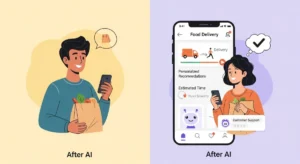 How Artificial Intelligence is reshaping Customer Experience in Food Delivery apps
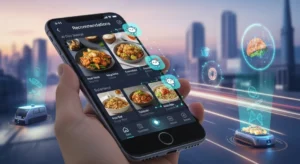 The Future of Food Delivery Mobile Apps – AI-based recommendations and Personalization
 Evolution of Voice Search and AI in Food Delivery apps
 How AI is Reshaping Mobile Apps in the Education Industry
