
The food app industry has undergone significant changes over the last decade. Initially started as a simple food ordering system over the phone, it has now transformed into a highly technical digital ecosystem. This is due to the emerging technologies like Artificial Intelligence, predictive analytics, data analytics, and machine learning.
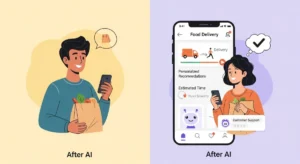
Today, customers expect more personalized experiences, accurate recommendations, seamless interactions, healthier choices, and fast delivery. The adoption of AI in food delivery apps will even provide more deeper level of smarter recommendations of products and personalization. This blog will detail how Artificial Intelligence is reshaping food delivery apps.

Why Personalization is important in Food delivery Mobile apps
Modern customers are overloaded with many options today. With hundreds of restaurant dishes, cuisines available at a single click, selecting the dish is becoming overwhelming for users. This is why personalization is necessary for a food app. According to recent trends, 80% of users prefer apps to customized choices based on their preferences. In exchange for better food recommendations, around 65% of the customers are ready to share their personal preferences. These personalized recommendations improve conversion rates and customer retention. Food apps will no longer depend on static menus; instead, using AI, they must develop a smart recommendation engine that learn customers’ habits, moods, and patterns. Utilizing vast amounts of customer data, AI makes this possible.
Transformation of Personalization in Food Apps by AI
AI-based personalization focuses more on understanding customers’ preferences, dietary restrictions, and budget, favourite dishes, ordering frequency, and even emotional choices.
AI-based Meal Recommendations
By analyzing various factors, AI predicts what customers may prefer to eat, like the time of the day, past order history, location, weather conditions, diet preferences, and based on the festival season. For example, on rainy days, AI can suggest snacks and soups to users based on their history. These AI-based personalized recommendations make customers feel like a personal assistant.
Hyper-Personalized Search
Instead of showing the restaurant list, AI will dynamically reorder the search as per the customer’s preferences. That is, two users will get different search results when they search for “pizza”. This is based on their ratings and ordering history. AI will save users’ data, including the restaurants they order from, their preferred food choices, the preferred delivery time, and the amount they spend on food apps. This optimization of AI will increase the conversion rates of food delivery apps.
Dynamic Pricing and Personalized Offers
In the case of food apps, offers play a major role. Providing the same discounts for all users will not be efficient. AI sends customized offers based on the frequency of orders, customer loyalty levels, nearby restaurant deals, and trends in order value.
Nutrition and diet-based food recommendations
Customers following diets are looking for better food items. Nutrition and diet-based personalization is provided by AI. It can suggest the best meals, track and count calories, and find allergen triggers. Mobile apps with advanced features even implement fitness trackers to provide meal recommendations based on fitness goals.
Food recommendations based on emotions
One of the merging trends in AI-based personalization is identifying emotions. AI finds user activities like search patterns, browsing time, and order cancellation to find their state of mind. It can match food preferences based on their moods.
How Food apps are powered by AI – Behind the scenes
Behind every order and delivery, there is a complex work of AI enhancing the customer satisfaction and efficiency. Multiple backend processes powered by AI offer users a personalized and smooth experience. Predictive analytics helps restaurants to reduce waste and manage inventory by forecasting peak hour order demand patterns and the most popular dishes. By using an ML algorithm, the app optimizes routes for delivery by analyzing the area traffic, driver availability, and weather conditions, thus offering seamless deliveries.
Through AI Chatbots, it handles customer support, answers user queries, resolves issues, and tracks orders. These chatbots act like humans. To prevent payment fraud, fake orders, and offer abuse, the app uses fraud detection systems that are powered by Artificial Intelligence. From delivery orders, AI is transforming the food delivery system into an intelligent ecosystem. This boosts profit and efficiency and also ensures that customers receive a more personalized, smarter, and faster experience.
Benefits of AI in the Food delivery business
- Improved customer loyalty – Personalized recommendations keep customers engaged.
- Smart Inventory management for restaurants – With the help of predictive analytics, AI ensures operational readiness and inventory management.
- Increased order values – Customized recommendations for users increase cross-selling and upselling opportunities.
- Reduces operational cost – AI helps in reducing food waste, delivery route optimization, and improves staffing.
- Improved Business insights – The User behaviour report is used to make better decisions for business growth.
Conclusion
The future of food delivery apps is powered by AI-based smart recommendations and personalization. The expectations of users are growing, and thus, food apps are evolving from simple ordering from a phone to an AI-based system that understands your mood, favorite dishes, choices, order timing, and more. Each and every step of the food delivery app is revolutionized by AI, from predicting orders to real-time food delivery. A food business that integrates these technologies will not only provide a luxury experience to users but also gain customer loyalty.
The future of food delivery apps is shaped by the combination of Artificial Intelligence, NLP. Machine Learning, Predictive Analytics, and AR?VR technologies. These make food apps interactive, intuitive, and impactful.
AI continues to grow, thus providing a higher level of personalization and making customers feel tailored suggestions.
Related posts:
 AI-Powered Food Delivery App Development: Personalization & Route Optimization
 How Artificial Intelligence is reshaping Customer Experience in Food Delivery apps
 AI Optimization of Food delivery journey – From order to delivery
 The Rise of AI Agents: How they are transforming industries
 Future proofing business with AI Agents – What to expect in the next decade
 The Role of AI in Startup Success: Smart Tools for New Entrepreneurs
