
Today, food apps are an essential one for many people across the world. This initially began with an order over the phone and has now expanded to a mobile app with advanced technologies. Artificial Intelligence plays a major role in today’s food delivery mobile apps, from ordering food to delivery.
With an increase in customer expectations, competition, quality, accuracy, and relentless need for speed, every food business should implement Artificial Intelligence to improve its business operations. AI in food apps is not an optional one; it is a mandatory one for every business to stay ahead of the competition.

Smart Food Order Processing
Artificial Intelligence analyzes the customer history, data, browsing patterns, and preferences. Using predictive analytics, it suggests food that users mostly prefer at specific times. In detail, AI studies the customer preferences like favourite restaurants, past orders, and cuisine types that they order. For example, if a user orders non-veg food on weekends, then the app will suggest non-veg-related foods. Based on time, trends, festival season, and weather conditions, AI suggests food to customers in real-time.
It pushes comfort snacks like soups and tea in rainy seasons. Voice assistants will even simplify food ordering. Customers can order food using NLP and make the process of food ordering more accessible and faster. AI ensures that customers are valued, understood, and given preference, and this helps in improved customer satisfaction and frequent orders.
Inventory and kitchen management
A well-managed kitchen that works efficiently is the reason behind each successful food business. Many restaurants face stock availability issues. AI solves this issue by adjusting when the stock is low, using real-time ingredient usage prediction to determine stock status, and reducing waste through seasonal demand forecasting.
To the correct delivery location, AI automates order routing. Queue management on busy hours, and Intelligent cooking based on historical data. AI will also forecast demand, help prepare semi-ready items, reduce delays, efficiently allocate manpower, and increase order acceptance. Managing the kitchen will improve the quality and the time.
Real-time order allocation
Allocating a delivery partner for each order is one of the biggest challenges faced by the food delivery business. AI turns this problem into an intelligent and streamlined decision-making system. Artificial Intelligence evaluates – traffic condition, driver location, vehicle capacity, and past performance.
For apps with different delivery options, AI allocates the best vehicle based on the distance, weather conditions, and order size. It helps in analyzing high-performance delivery persons and providing them with incentives, and boosting overall business productivity. This, in turn, increases customer satisfaction and reduces waiting time.
Artificial Intelligence in Navigation and Route Optimization
After the order is accepted, the next goal will be reaching the delivery address quickly. Traditional GPS is no longer sufficient; AI predicts traffic by using GPS data, traffic sensors, and historical trends. This identifies road closures, Congestion, and weather conditions. Geo-mapping and short routing identify the shortest path, multiple delivery options for bulk orders, and AI-based rerouting.
AI in improving delivery experience
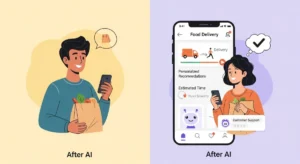
Communication with customers plays a major role in trust and transparency. AI improves communication in every aspect. Automated status update includes food preparation status, order confirmation, estimated delivery time, and driver location. It also predicts the delivery time based on restaurant queue, real-time traffic, weather, and driver availability. This improves trust and reduces uncertainty. Chatbots offer support like order changes, complaints, tracking queries, and refund issues. These AI-based chatbots offer 24/7 support.
Post-Delivery Analytics
Each and every delivery becomes data for service improvements. AI analyzes these data from customer reviews, complaint notes, ratings, and service chats. This post-delivery analytics helps businesses to track driver efficiency, delivery time performance, peak-hour performance, and food preparation delays.
Security and Fraud detection
Payment disputes, fake complaints, and fraudulent orders are efficiently handled by AI. It also identifies fake addresses, repeated refunds, bots placing orders, and multiple accounts with the same payment.
AI helps in safe transactions
It ensures secure payment processing, the prevention of unauthorized activities, and the monitoring of unusual activities. This improves trust among customers.
Reason why the Food business should adapt to AI
Food delivery businesses that fail to adopt AI will face a higher risk. AI is non-negotiable because AI improves customer satisfaction and delivery time, reduces operational cost, increases transparency and reliability, improves safety and security, and boosts sales and conversion.
Personalized marketing offers
AI analyzes the buying habits of users, order frequency, favourite cuisines of users, and geographic locations. Based on the demand, it adjusts the pricing, increases the pricing during peak hours, gives special offers during low hours, and also provides seasonal deals. To increase conversion rate, AI sends personalized discounts and offers to customers.
Future of AI in the Food delivery business
- Food delivery using Drones – AI helps in path planning and hurdle avoidance.
- Robotic deliveries – help in delivering food autonomously and reduce human dependency.
Conclusion
With the evolution of AI in the food delivery business, the journey is not simple; it involves an intelligent ecosystem, highly data-driven and automated. AI offers predictive smart orders, dynamic routing, inventory management, and custom engagement. It helps in improving accuracy, satisfaction, efficiency, and speed. Now, AI is a necessity; it is not an option in today’s competitive world. To meet customers’ expectations, each business needs to adapt to the emerging trends to stay strong in this business. Artificial Intelligence ensures that each food that reaches customers is fresh, hot, and it should be delivered at their doorstep.
Related posts:
 AI-Powered Food Delivery App Development: Personalization & Route Optimization
 How Artificial Intelligence is reshaping Customer Experience in Food Delivery apps
 Can AI replace SaaS? Exploring the Evolution of Software Models
 The Rise of AI Agents: How they are transforming industries
 Future proofing business with AI Agents – What to expect in the next decade
 The Role of AI in Startup Success: Smart Tools for New Entrepreneurs
