
Artificial Intelligence and Voice Search are playing a major role in the food delivery industry today. Customers expect a fast, personalized, and intuitive food ordering experience nowadays. This transformation is further moved to voice search. From hands-free food ordering to personalized recommendations, intelligent experience, and automated support.
The integration of AI and voice Search is reshaping the future of the food delivery business. This blog details how AI and VoiceSearch are revolutionizing the food delivery business and the benefits for both businesses and customers.

Voice search and Artificial Intelligence’s Evolution in Food Delivery apps
Over the last decade, the food delivery industry has changed drastically. The next transformation is Artificial Intelligence and Voice Search. Users no longer need to track their orders manually or browse for their favourite food through endless options rather now they can get a more personalized and effortless ordering experience.
With the growth of voice assistants like Google Assistant, Alexa, and Siri, voice search has grown. Instead of typing, users prefer speaking to get their search results. This voice search option improves accessibility and supports multitasking. Customers can simply order food by saying “ order butter chicken from the nearest restaurant”, “Track my food delivery”.
More in-depth intelligence is added to this experience with the help of AI. To provide customized food orders to users, it studies past orders, user behaviour, current trends, and cuisine preferences. AI and Voice Search improve speed, customer convenience, and personalized recommendations in food delivery.
How Artificial Intelligence is Transforming Food Delivery apps
AI plays a major role in every layer of the food app system, beyond basic recommendations. AI algorithms used in modern food delivery apps analyze huge user and restaurant data, helping them to improve efficiency, automate processes, and improve customer satisfaction.
- AI in Customer Support – AI chatbots handle customer queries, like refund questions, order status, and expected delivery time. These chatbots ats like humans.
- AI in Search – Based on customers’ suggestions and preferences, AI identifies what they will order at a specific time. A user who orders non-veg dishes will receive suggestions like fried chicken, Mutton biryani, and many.
- AI in Route Optimization – To find faster routes and shorter ones based on traffic, road conditions, and weather, delivery partners depend on AI. This improves customer experience and reduces delivery delays.
- AI in Inventory Management – AI in inventory management helps in planning ingredient shopping, predicting peak our demands, and reducing waste.
Seamless Ordering experience with the help of Voice Search
Voice search made food ordering more natural, user-friendly, and convenient. Instead of tapping for menus, users can speak and give commands to order, browse, track ordering, and more.
- Reordering- With a quick command like” reorder my last meal”, customers can reorder easily.
- Search filters – Instead of typing and manually using filters, customers can order by speaking “ list non-veg items under 500”, and the food app will display all the relevant items.
- Customer Support – Using voice search, customers can ask to track their order.
This Voice search is more useful while working, driving, or cooking. It makes the food ordering easier, faster, and simpler. If this voice search becomes more perfect and multilingual, this will be the default option for users to order food.
Impact of AI and Voice Search Combination in the Food Delivery Industry
The combination of AI and Voice Search will give benefits to both customers and businesses.
- Increased Revenue and Customer Engagement – A user-friendly ordering experience gives more orders and repeat customers. Personalized recommendations encourage users to try new offers and dishes.
- Improved business efficiency – AI provides demand forecasting, delivery route optimization, inventory management, and staff planning.
- Low cost for customer support – AI-based chatbots provide 24/7 support, thus reducing the need for a customer support team.
- Improved Marketing Campaigns – AI helps businesses run campaigns, Weekend offers, Lunch combos, Festival offers, and Healthy meal packs.
- Increased Customer Satisfaction – Personalized food ordering experience, quick issue resolutions, faster deliveries, and accurate voice recognition build a strong customer base.
The future of Food Delivery
The advancement in AI and Voice Search will make the food delivery business intuitive, predictive, and proactive.
- Predictive Analysis – Based on weather, mood, time, and past habits, AI will predict user cravings.
- A fully voice-operated app – Users will be able to complete every step of the ordering process through voice, searching for dishes, selecting the item, adding to cart, applying if any, making payments, and placing orders.
- Emotion-based voice search – The Future will recommend food based on the voice of the customers.
- Multilingual Support – To make technology accessible to all people, the system will support all languages, including Tamil, Malayalam, Kannada, Telugu, and many.
Conclusion
AI and Voice Search is now reshaping the food delivery industry nd this not an emerging trend anymore, they now reshaping the industry
Voice search and artificial intelligence are no longer emerging trends—they are now powerful forces reshaping the food delivery industry. Together, they create a smarter, faster, and more intuitive experience for customers who expect convenience at every step. From personalized meal recommendations and hands-free ordering to real-time delivery updates and AI-driven customer support, these technologies are redefining how people interact with food apps. For businesses, AI and voice functionality bring improved operational efficiency, better demand forecasting, reduced support costs, and stronger customer engagement, all of which directly contribute to higher revenue and long-term loyalty.
As the industry continues to evolve, the integration of AI and voice technology will become a standard rather than an optional feature. Future food delivery platforms will be able to predict a user’s cravings, understand regional languages, detect emotions through voice, and offer hyper-personalized suggestions that go far beyond today’s capabilities. The companies that adopt these innovations early will stand out by offering seamless, human-like digital experiences. In short, the future of food delivery is intelligent, personalized, and driven by voice and AI—and the revolution has already begun. Businesses must embrace it now to stay competitive in this rapidly transforming market.
Related posts:
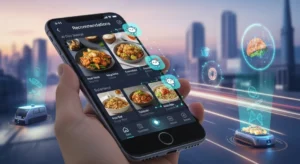 The Future of Food Delivery Mobile Apps – AI-based recommendations and Personalization
 AI-Powered Food Delivery App Development: Personalization & Route Optimization
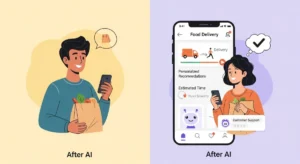 How Artificial Intelligence is reshaping Customer Experience in Food Delivery apps
 AI Optimization of Food delivery journey – From order to delivery
 The Rise of AI Agents: How they are transforming industries
 Future proofing business with AI Agents – What to expect in the next decade
