
Reducing operational costs without affecting work efficiency is crucial for business owners. Controlling operational costs has become a top priority for many businesses due to increase in labor costs, inefficient workflows, and outdated software that impacts profit. Many businesses may invest in generic software due to its less initial investment but it may come up with poor features, less customization, and recurring subscription costs that fail to address unique business needs.
In this case custom software is designed according to unique business needs, which helps to align with your unique operational needs, and to reduce operational costs. In this blog, let us explore how custom software solutions reduce operational costs and help for long term ROI.
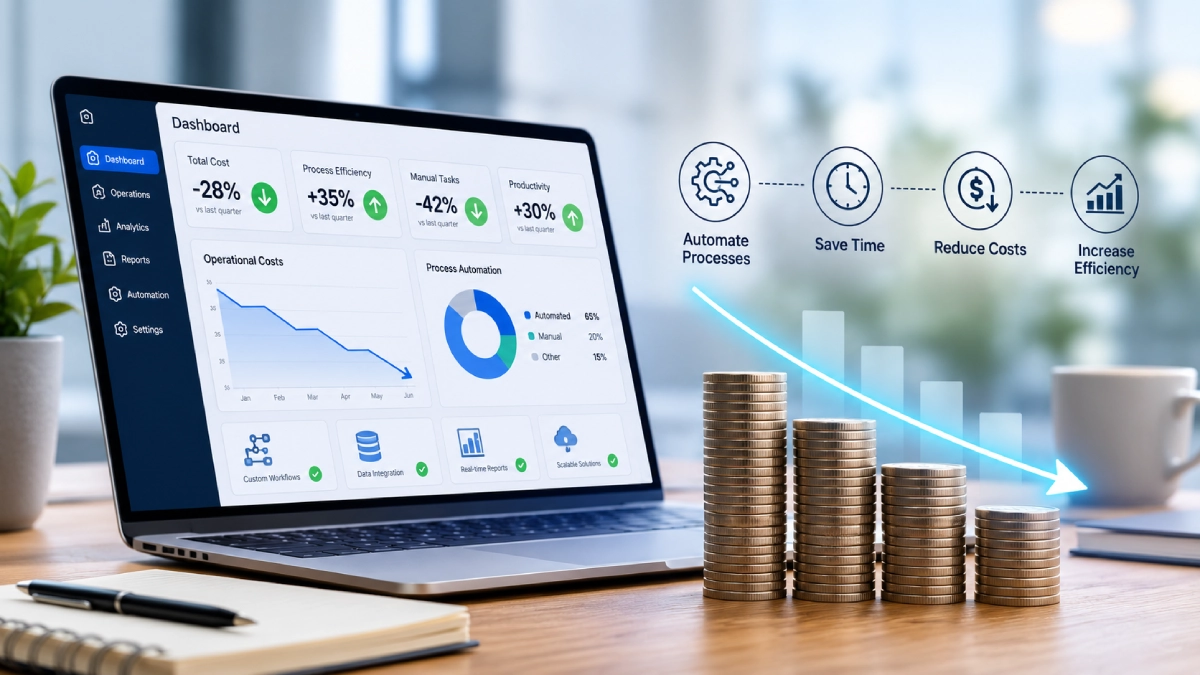
Why Businesses Face High Operational Costs
Most of the businesses may invest more than the basic needs due to ineffective processes and disconnected tools. When businesses grow, handling operations through spreadsheets, emails, and multiple software tools may lead to more time consuming and expensive. By facing these challenges operational cost will be increased, productivity and client satisfaction will be reduced. Investing in the right software will help businesses to overcome these challenges efficiently. Some of the important reasons for increasing in operational costs are,
- Repeated tasks with manual support
- Human mistakes by manual data entry
- Poor communication between departments
- Lack of real time business data
- Inefficient resource allocation
- Delays in decision making
4 Ways Custom Software Reduces Operational Costs
1. Automating Repetitive Business Tasks
In businesses, manual activities like data entry, invoice generation, attendance tracking, report creation, and order processing may take more time daily to complete. But investing in custom software helps to automate the daily repeated tasks, and it allows employees to focus on initiating new innovative business strategies which improves growth. By this automation human error can be reduced, consistency will be improved, and helps to speed up daily operations, leading to reduced operational costs.
2. Eliminates Multiple Software Subscriptions
This is one of the important ways to reduce operational costs by eliminating various software subscription costs. Most of the businesses may depend on multiple tools for accounting, inventory tracking, client relationship management, and project management. Paying for each and every software license will be expensive and challenging to handle. In this case, a well designed custom software integrates basic business features into a single tool, which reduces subscription costs, and improves collaboration across teams.
3. Reducing Human Errors
Another important way custom software reduces operational costs is by reducing human mistakes like invoices, inventory records, client information, or financial reports lead to additional cost. Businesses using custom software are able to automate validations, improves workflows by reducing manual errors. By this operational accuracy can be improved which not only saves money but also improves client trust and operational efficiency.
4. Improves Employee Productivity
Custom software reduces operational costs by improving employee productivity. Productivity can be improved when employees have quick access to the tools and data they want. By investing in custom software, businesses can centralize data, automate the task, and communicate better communication, which helps teams to complete tasks efficiently. By this productivity can be improved and businesses can manage high workloads without increasing operational costs.
4 Ways Custom Software Saves Money
1. Optimizes Resource Management
One of the major disputes businesses may face is using the resource effectively. Business owners may face challenges to allocate employees, equipment, or budgets without proper data. By investing in custom software, businesses can get real-time dashboards and analytical reports that help businesses to track workflow, tracking progress, and allocating resources. This improves overall productivity and saves money without spending on unnecessary things.
2. Scales with Your Business
When business grows, its operational needs become more complicated. Using generic software may need expensive upgrades or additional tools to implement new processes. A well developed custom software with scalability helps for adding new features, modules, and integrations can be done easily for business expansion. By scalability business can save cost in the long term.
3. Improves Decision Making with Real-Time Data
Unnecessary expenses may be required when a business makes decisions with outdated or incomplete data. Business investing in custom software can collect all data from various departments into a single platform. By getting the real time access to sales, inventory, employee performance, client activity, and financial reports business efficiency can be improved. By this data, business owners can make better decisions that improve ROI and save money.
4. Improves Customer Experience and Retention
A well developed custom software for businesses helps to provide faster service, personalized communication, and good client support. For instance, a custom CRM software helps for better sales and support teams to access full client data quickly, and supports responding to inquiries quickly, and resolving issues efficiently. By improving customer satisfaction, loyalty can be improved, and helps business by reducing client acquisition costs.
The Long Term ROI of Custom Software
For businesses investing in custom software development will be high but in the long term it helps for better ROI. Some of the advantages of using custom software for businesses are,
- Helps for less operational costs through automation
- Reduces software licensing and subscription costs
- Improves employee productivity
- Supports for better data insights
- Helps for more client retention
- Helps for high scalability
Conclusion
Thus from the above blog discussed, custom software solutions reduce operational cost by automating repeated tasks, avoiding unwanted software costs, improving resource usage, and by data driven insights which helps business for long-term success. Whether you are a startup looking to improve operations or an enterprise looking to enhance efficiency, investing in custom software development will help for reducing operational costs and productivity. benefits. Choose Smarther technologies as your custom software development company, contact us today for a free demo!
Frequently Asked Questions
+
+
+
+
+
Related posts:
 Employee Time-off Management Software
 Project Management Tool
 10 Common Mistakes to Avoid in Custom Software Development Projects
 Top 10 Benefits of Custom Software Development for Growing Businesses
 CRM Software Development its Benefits, Process, and Features
 The Importance of CRM in Real Estate: How It Drives Sales and Efficiency
