
In today’s digital world, depending on spreadsheets like traditional methods will be difficult for businesses to handle leads, clients, sales tasks, and communication. In this case, a CRM software helps businesses to access complete client data, automate repetitive tasks, manage sales, and improve communication. Without a CRM system, businesses can face many challenges that affect sales, productivity, client satisfaction, and business growth. In this blog, let us explore the common challenges businesses face without CRM software.
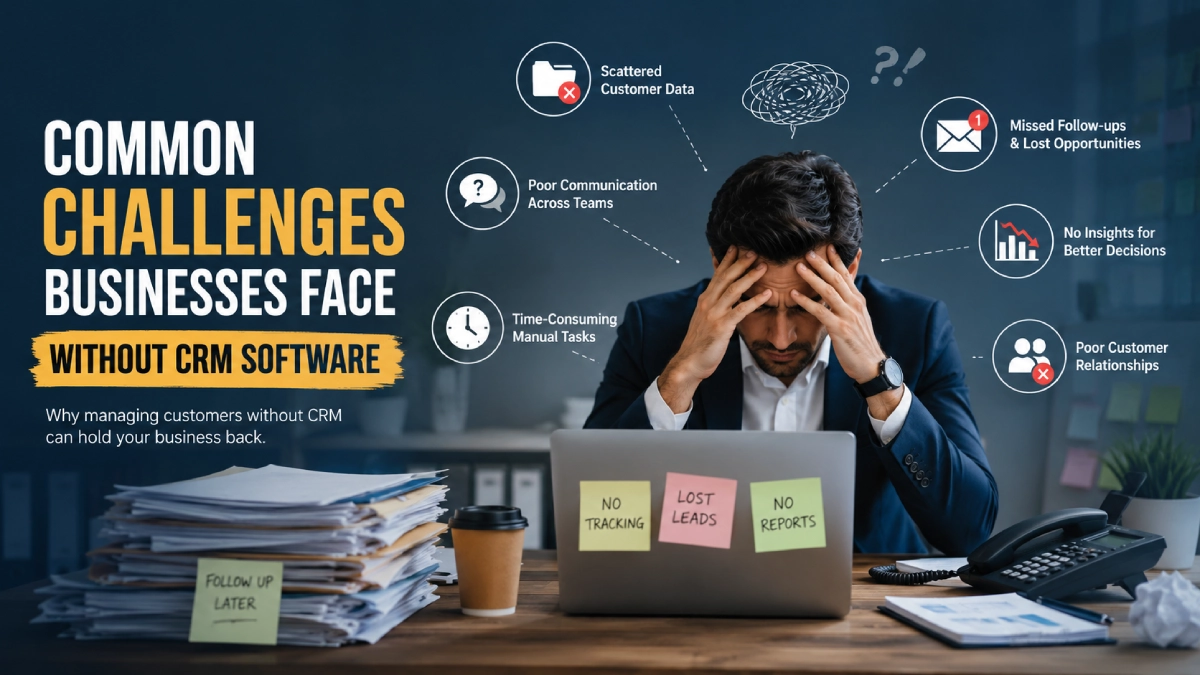
1. Disordered Customer Data
One of the common challenges businesses face without CRM software is disordered client data. Businesses may face managing client information which can be stored in various tools using spreadsheets, emails, documents, messaging apps, and other individual devices. But identifying exact customer data becomes difficult. In this case, a CRM software stores client data in a single dashboard, which helps employees to access contact information, purchase history, and other relevant information easily.
2. Managing Leads Difficulty
Another important challenge businesses face without a CRM software is managing leads efficiently. In businesses, lead flow will come from various sources like websites, phone calls, social media, email, and other online platforms. When sales teams follow up these leads manually, it may lead to missed opportunities and less conversion rates. Business investing in CRM software enables businesses to capture, organize, assign, and track leads throughout the sales process.
3. Missed Follow Ups
Following up clients at the right time is very important for business sales. Without using CRM software employees may depend on spreadsheets, calendars or memory to remember follow up tasks. By following up various clients, employees may forget important qualified leads to follow up. In this case, using CRM software can help with providing automatic notifications for calls, meetings, emails, and other sales tasks that lead to maintaining good communication with customers consistently.
4. Poor Sales Visibility
For better sales performance, at first businesses need to understand the sales funnel for where the leads are coming and according to that we can improve sales prospects. If not considering this, sales forecasting will be challenging. Using CRM software, we can get a visual sales pipeline that helps the sales team to track opportunities and implement the sales growth opportunities. Without a using CRM software sales team may face challenges to decide how many leads are,
- Newly generated
- Contacted
- Qualified
- Negotiating
- Waiting for a proposal
- Converted
- Lost
5. Poor Client Communication
This is the common challenge businesses face without CRM software. Businesses using CRM software helps for better client communication. Communication between clients and business may occur through call, email, WhatsApp, social media channels, or website forms. Businesses without CRM software may face the difficulties to access the full history of clien data. This can lead to repeated questions, inconsistent responses, and poor custom. A well designed CRM software helps to centralize client interactions, and helps the sales team for a better understanding of client history and needs.
6. High Manual Work
Most of the businesses still rely on manual support for activities like data entry, lead assignment, reporting, client follow up and updates. Completing these tasks may take time for employees with the possibilities of human errors. In this case, investing in CRM software helps for automating repetitive tasks. For instance, if a new lead enters into the system, CRM software helps to assign the lead to a sales team automatically with follow up support. This helps employees to spend their time more on growth implementations activities.
7. Less Customer Data
Customer data is very important for businesses and it should be used effectively for maintaining a good client relationship. Businesses without CRM software may face the challenge of analyzing client data, purchasing patterns, client preferences, and possibilities of sales opportunities. A well developed CRM software helps for providing reporting and analytics tools for getting client insights. By getting these valuable insights, businesses can enhance marketing strategies, and client experiences.
8. Tracking Employee Performance
Tracking employee performance will be challenging for the sales team and client service managers without accurate and detailed working data of employees. Businesses without CRM software may face the challenge of tracking every individual employee’s tasks and it’s difficult to know who and how many leads are handled by the sales team. Business considering CRM software helps to provide a unified dashboard which helps for data like performance and reports that help managers track metrics like lead conversion rates, sales task, total revenue gained, and overall performance.
9. Poor Team Collaboration
We may know that team collaboration is very important for business growth and success. But when client data is stored separately in various systems, collaboration becomes difficult. This leads to communication gaps and affects client experience. A well designed CRM software helps teams to access the same client data which helps to improve team collaboration between sales, marketing, client support, and management.
10. Difficulty in Scaling Business Operations
Business using manual software will be suitable only for a small business with a smaller number of clients. But when business grows, handling more clients manually becomes complex. When more clients enter into the business then more data, communication, leads, and sales activities will occur. Without using scalable CRM software, businesses may face operational challenges.
How CRM Software Solves These Challenges
Investing in CRM software helps businesses to avoid facing various challenges. A well developed modern CRM for business helps for,
- Complete client data
- Lead and contact management
- Sales tracking
- Automated follow ups
- Workflow automation
- Client communication management
- Sales reporting and analytics
- Marketing automation
Conclusion
Thus, running a business without CRM software can be a challenge for firms to manage clients and sales. A well developed CRM software helps businesses by providing client information, automating repetitive tasks, and by improving team collaboration. Businesses considering CRM software can enhance productivity, improve client experiences, and support long term growth. As a business owner if you are looking for the best CRM software development company choose Smarther technologies for better foundation to manage client relationships effectively. Contact us for a free consultation!
FAQs
1. What challenges can CRM software solve for businesses?
CRM software helps businesses to solve challenges like less client data, follow ups missing, poor sales tracking, manual processes, and communication issues. CRM software centralizes data and enhances overall business productivity.
2. Why do businesses need a CRM software?
Businesses need a CRM software to handle client relationships, automating sales tasks, monitoring leads and client interactions. A well designed CRM software helps businesses to make right decisions and improve client retention.
3. How does CRM software improve sales and productivity?
Investing in CRM software helps businesses to improve sales productivity by automating repeated activities, providing proper follow up reminders, tracking sales, and by providing real time reports.
4. Is CRM software suitable for small and growing businesses?
Yes. CRM software will be suitable for small and growing businesses by getting complete data insights of client data, improving sales processes, and automating repetitive activities.
Related posts:
 How AI is Transforming CRM Software Development in 2026
 Top 10 CRM Features Every Business Needs in 2026
 Common Challenges Businesses Face Without Custom Software Solutions
 When Should a Business Invest in Custom Software Development?
 Top 10 Free Vibe Coding Tools in 2026
 How Custom Software Improves Business Efficiency and Productivity
